
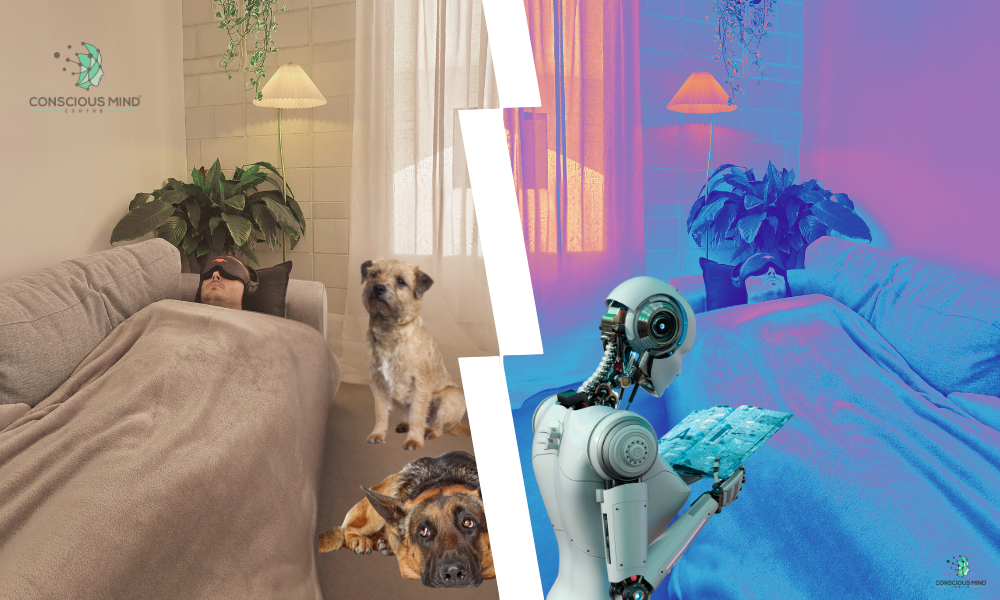
Man vs Machine – Robot Sitters
Written by Shai Hipperson
Disclaimer: This article is for educational and harm reduction purposes only. It does not constitute medical advice or therapeutic recommendations. If you are experiencing mental health concerns, please consult with a qualified healthcare professional. The therapeutic use of psychedelics requires proper medical supervision under current Australian regulations.
In Australia, therapeutic use of psychedelics is regulated by the TGA and can only be prescribed by authorised psychiatrists for specific conditions. This blog discusses general harm reduction principles and is not intended to promote or advertise any specific therapeutic interventions.
Last month, WIRED magazine published a story about people using Ai chatbots, and other tech bro apps as trip sitters to take large doses of psychedelics.
You may be wondering how this could be problematic or why I think your dog would be a better sitter – strap in.
Our world of technology is moving incredibly quickly, I am unsure as to whether the tech industry themselves can keep up. We are well and truly in a massive technology revolution but we need to ensure there is proper oversight to this especially in the mental health space.
Why your dog would make a better trip sitter than AI?
Dogs are emotionally intelligent, they can sense when things are not quite right and they can emotionally attune to our distress. Research shows, domestic dogs can recognise the emotions of humans and other dogs through a combination of auditory and visual cues, and by integrating this bimodal sensory information dogs can differentiate between positive and negative human emotions (Albuquerque et al., 2016; Merola et al 2013). A systematic review found that support animals and domestic pets “provide owners consistent and proximate source of calming support and companionship”, this was found to be enhanced when support was needed particularly in time of crisis. Further, the review found pets supported owners in maintaining a positive sense of self-identity, and reported a sense of acceptance without judgement from their pets (Brooks et al., 2018). These findings highlight the role dogs play in our lives, mental wellbeing, and provide some evidence to support why a dog would be a better trip sitter than Ai.
Pillars of Safety
Trip sitting is an important pillar of psychedelic safety, under the influence of these powerful medicines many things can and do go wrong. At Conscious Mind Centre, we receive enquiries from individuals seeking information about psychedelic-related concerns. Trip sitting is not just about physical monitoring, it is ensuring the journeyer is grounded, but can move through their experience in a safe container. Psychedelic safety starts with set and setting. This is not something Ai can replicate or replace appropriately trained or qualified professionals. Reason being is ai is trained to be information smart, smarter than a collective of human brains at once. Ai can digest information faster, and it can regurgitate text based information better than any human, even plagiarizing information. The downfall here is Ai is capable of reaffirming your thought process, it is capable of telling you what it knows from textbooks, and it can do this at a fraction of the cost of a professional right from your bedroom.
The problem of Ai as a trip sitter? – when you start to become paranoid, your visual experience becomes emotionally overwhelming and your nervous system cannot cope, you start to experience delusional thinking, you are edging on a psychotic episode, you have prolonged persistent psychedelic visuals (known as HPPD), you experience an existential crisis, your world perception is flipped on its head. Ai will not interrupt this process but may actually reinforce it. Recent publications highlight the risk of psychosis and mania onset precipitated or perpetuated by the use of Ai, see here and here. Ai does not have the capacity of emotional attunement or empathy like another human, or your dog, and it sure as heck does not have the clinical insight or knowledge of knowing when to intervene for the matter of your safety and wellbeing.
While your dog may not be able to speak the same dialect, your dog understands your emotional sense and distress, it’s also helpful your dog cannot reinforce your difficult psychedelic experience by echoing your distress.
Set, Setting & Unregulated Sitters
The foundations of psychedelic safety start with set and setting. Set is the mindset you have going into the medicine, setting is your physical environment including those who are trip sitting you. Trip sitters hold the space, they are responsible for the safety of those in the space. In a clinical setting, our team includes mental health professionals who have undertaken additional training in psychedelic-assisted therapy, working within current regulatory frameworks, and ethical guidelines. Our role is to ensure you are suitable for this treatment, and ensure your psychological and physiological safety throughout treatment.
Unregulated trip sitters generally are not accredited, insured, or regulated – this poses significant risk to the general public without understanding the full risks involved. Knowledge is power, and knowledge allows you to make an informed decision about your future. Some individuals report persistent negative effects from psychedelic use, and recovery experiences vary significantly between individuals. With the right professionals, with the right support – you can improve your wellbeing. Psychedelic injuries are real, they can be serious, and the risk of Ai inducing them is significant.
If you have concerns about any altered state-related experiences, we encourage seeking support from qualified mental health professionals who can provide appropriate guidance.
References
Albuquerque, N., Guo, K., Wilkinson, A., Savalli, C., Otta, E., & Mills, D. (2016). Dogs recognize dog and human emotions. Biology letters, 12(1), 20150883. https://doi.org/10.1098/rsbl.
Brooks, H.L., Rushton, K., Lovell, K. et al. The power of support from companion animals for people living with mental health problems: a systematic review and narrative synthesis of the evidence. BMC Psychiatry 18, 31 (2018). https://doi.org/10.1186/
