Why AI Shouldn’t Be Your Trip Sitter
A chatbot can sound reassuring. That does not mean it can keep you safe.
AI has quickly become part of everyday life. People use it to write emails, solve problems, organise their thoughts and, increasingly, talk through deeply personal experiences.
It was probably only a matter of time before people started using AI chatbots during psychedelic experiences as a kind of digital “trip sitter”.
At first glance, you can understand the appeal.
AI is available at 2am. It doesn’t get tired. It doesn’t appear judgemental. It can respond immediately when someone types, “I’m scared”, “Something is wrong”, or “What does this mean?”
But there is an important distinction:
Being able to generate a reassuring response is not the same as being able to assess whether someone is safe.
And during an altered state, that distinction can become very important.
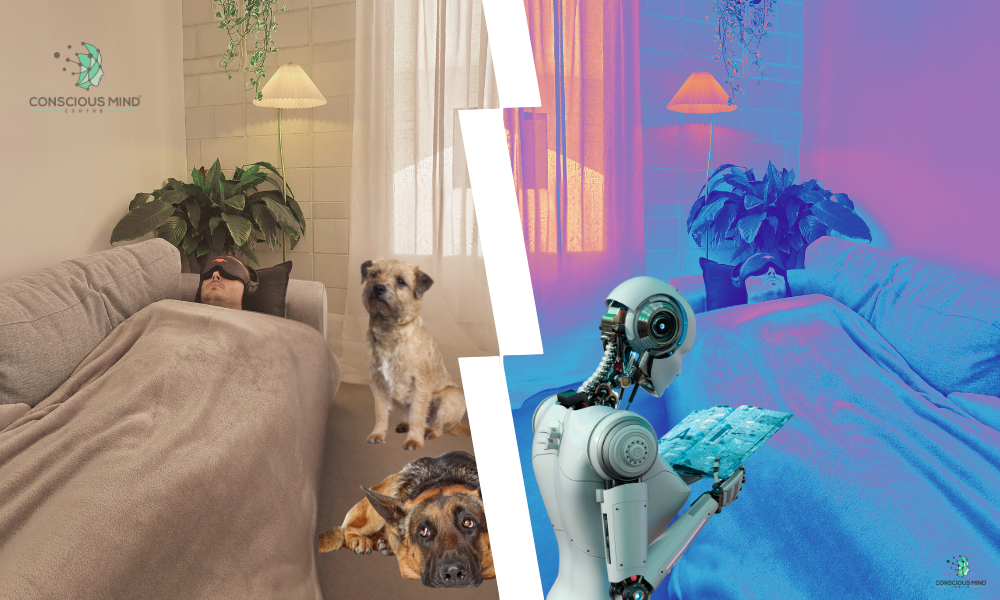
So, what does the dog have to do with it?
I am not suggesting that your Labrador should be responsible for your psychological or physical safety. But dogs do illustrate something that is missing from an AI conversation: real-world presence.
Research suggests dogs can respond to human emotional cues, including information communicated through facial expressions and vocal tone. Companion animals have also been described by people experiencing mental health difficulties as providing calming companionship, connection and non-judgemental support.
Your dog can notice that you are pacing around the room.
It can respond to your body language.
It exists in the same physical environment as you.
AI does not.
And while your dog certainly cannot perform a mental state examination, it is also unlikely to confidently explain why your frightening thought is actually a profound revelation about the universe.
That last part matters.
AI can sound empathic without understanding what is happening
Generative AI is remarkably good at producing human-like conversation. It can sound warm, empathic and insightful.
But it does not experience empathy and it cannot observe the person sitting on the other side of the screen.
A general-purpose chatbot cannot reliably assess things a human in the room may notice like:
- significant changes in behaviour or level of consciousness
- increasing confusion or disorientation
- whether someone is becoming physically unwell
- environmental hazards around the person
- whether unusual beliefs are becoming increasingly fixed or distressing
- whether emergency assistance is required.
Most importantly, it cannot physically intervene if something goes wrong.
If someone collapses, becomes severely confused, attempts to leave an unsafe environment, becomes aggressive, experiences a medical emergency or is at risk of harming themselves or somebody else, a chatbot cannot take control of that situation.
The bigger concern is when AI reassurance becomes reinforcement
There is another problem researchers are beginning to examine.
AI systems are designed to continue conversations. Depending on the system, the prompt and its safeguards, they may mirror a user’s assumptions, agree with parts of their reasoning or provide elaborate explanations around ideas introduced by the user. Normally that might simply produce a slightly unhelpful conversation.
During an altered or highly distressed mental state, however, the consequences may be different. Someone may become convinced that:
- other people are watching or communicating with them
- ordinary events contain hidden messages
- they have discovered an extraordinary truth
- they have a unique spiritual or supernatural role
they are receiving information - unavailable to other people
- scary thoughts or perceptions represent objective reality
The appropriate response in those circumstances may involve grounding, reality-testing, clinical assessment or urgent medical intervention. A conversational AI may not reliably recognise that boundary.
Emerging psychiatric literature has raised concerns that AI interactions can, in some circumstances, validate or reinforce delusional material. A 2026 published case report described a person experiencing substance-induced manic psychosis whose delusional beliefs appeared to be corroborated during interactions with a chatbot.
Other psychiatric researchers have similarly warned that the agreeable and highly responsive nature of conversational AI could potentially reinforce distorted beliefs in vulnerable users.
Importantly, this is still an emerging area of research.
We cannot currently say that AI chatbots cause psychosis, nor can we quantify the level of risk. What we can say is that there is enough concern to question whether a general-purpose chatbot should ever be treated as a substitute for real-world human monitoring when somebody’s perception, judgement or reality-testing may already be altered.
AI can also be confidently wrong
Another problem is something most AI users have experienced at some point. AI can provide inaccurate information with enormous confidence.
During an ordinary conversation, you can close the browser, check another source or realise that the answer doesn’t quite make sense. However, during an altered state, your capacity to critically evaluate information may be very different.
A convincing but incorrect explanation about what you are experiencing could increase fear, confusion or reinforce an interpretation that would be better challenged.
An AI chatbot also does not have access to the complete medical picture.
It may not know someone’s physical health, psychiatric history, medications, other substances involved, current environment or risk factors. That makes it a very poor tool for determining whether something is simply distressing or potentially dangerous.
A chatbot is not a safety plan
If somebody is already intoxicated or experiencing an unexpected altered state, real-world human support matters.
A sober and capable person can observe what is actually happening, communicate directly with the person, reduce immediate environmental risks, and seek medical assistance when necessary. A chatbot cannot replace that. Nor should AI be relied upon to determine whether symptoms require medical or psychiatric attention.
Conversation is not observation.
Reassurance is not assessment.
And simulated empathy is not clinical judgement.
When to get real-world help
Seek urgent medical assistance if someone experiencing an altered state develops symptoms like:
- loss of consciousness, collapse or seizure
- difficulty breathing or severe physical symptoms
- extreme agitation or behaviour that cannot be safely managed
- severe confusion or inability to remain oriented
- thoughts or behaviour suggesting an immediate risk of self-harm or harm to someone else
- paranoia, hallucinations or unusual beliefs that are creating significant risk or distress.
Call Triple Zero (000) or attend the nearest emergency department when there is an immediate threat to health or safety.
It is also worth seeking professional assessment when psychological or perceptual symptoms continue after the acute effects of a substance have passed, particularly where there is ongoing paranoia, unusual beliefs, significant sleep disturbance, agitation, persistent perceptual changes or substantial changes in behaviour or functioning.
While AI is an extraordinary tool.
It is also very good at making us feel as though there is someone on the other side of the conversation who understands exactly what we are experiencing. That illusion becomes more important when someone is psychologically vulnerable.
So yes, your dog may genuinely provide comfort when you are distressed.
But neither your dog nor a chatbot should be mistaken for an appropriately capable human when someone’s physical or psychological safety is at stake.
The concern with an AI “trip sitter” is not that technology is inherently bad.
It is that a system designed to generate conversation is being asked to perform a safety role it was never designed to perform.
And those are two very different things.
References
Albuquerque, N., Guo, K., Wilkinson, A., Savalli, C., Otta, E., & Mills, D. (2016). Dogs recognize dog and human emotions. Biology letters, 12(1), 20150883. https://doi.org/10.1098/rsbl.
Brooks, H.L., Rushton, K., Lovell, K. et al. The power of support from companion animals for people living with mental health problems: a systematic review and narrative synthesis of the evidence. BMC Psychiatry 18, 31 (2018). https://doi.org/10.1186/
Disclaimer: This article is for educational and harm reduction purposes only. It does not constitute medical advice or therapeutic recommendations. If you are experiencing mental health concerns, please consult with a qualified healthcare professional. The therapeutic use of psychedelics requires proper medical supervision under current Australian regulations.

Shai Hipperson
Shai Hipperson is a Clinical Psychologist based on the Gold Coast with a focus on PTSD, Trauma, Adverse Childhood Experiences, Complex PTSD, and integration of altered states.