Medicine-Assisted Therapy for Veterans Queensland
Access, Treatment Pathway, and the DVA Process
If you’re a DVA card holder in Queensland with treatment-resistant PTSD or depression, you may be eligible for Medicine-Assisted Therapy through DVA’s funding pathway. This page will help you understand the requirements and there is a self-screening assessment tool to determine if you may be suitable for further clinical evaluation.
If you are new to Medicine-Assisted Therapy, this may be a good place to begin:
Table of Contents
Self-Assessment Screening Tool
Disclaimer: All treatments involving restricted medicines are administered under the TGA’s Authorised Prescriber Scheme. We do not promote the use of any specific Schedule 8 or Schedule 9 substances. All treatment decisions are made by registered medical practitioners based on a comprehensive clinical assessment of risks and benefits. Funding is subject to DVA approval, submitting an application does not guarantee approval. Our clinic provides the documentation required for the DVA to make an informed decision.
This assessment and the information on this page are for educational purposes only and do not constitute medical advice or replace consultation with qualified healthcare practitioners.
The cave you fear to enter holds the treasure you seek.
Joseph Campbell Tweet
The DVA Funding Pathway
The Department of Veterans’ Affairs (DVA) now provides a specific funding pathway for Psychedelic-Assisted Psychotherapy (PAP) under strict conditions. This is considered a fourth-line treatment, meaning it is only accessible after other evidence-based therapies have been exhausted.
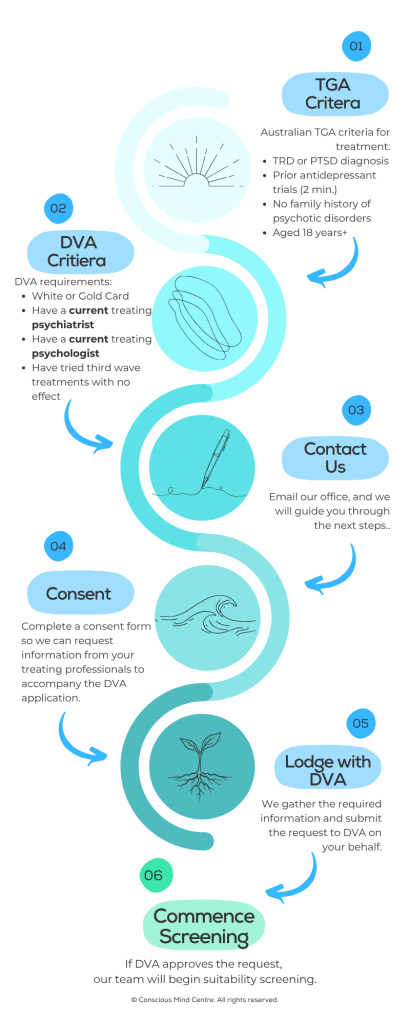
Eligibility Criteria to apply for DVA Funding:
Treatment Pathway for DVA Veterans
We understand that navigating DVA funding and treatment applications can feel overwhelming, that is why our team are here to make the process as clear and supported as possible.
Before a DVA funding application can be lodged, Veterans first need to consider whether they may meet the current TGA criteria for Medicine-Assisted Therapy, as well as DVA’s funding requirements. This treatment is only available for specific approved conditions.
The Next Steps
If you choose to proceed, you may be asked to complete a consent form so that relevant treatment history can be requested from your treating professionals. This may include information from your GP, psychiatrist, psychologist, or other clinicians involved in your care.
Once the required information has been gathered, we will prepare and submit the funding application to DVA. The estimated DVA turnaround time is approximately 28 days, although this can vary up to 12-months of additional information is required and pending DVA’s processing times.
If funding is approved, veterans may then begin the clinical suitability screening process.
Please note that DVA funding approval does not automatically mean that treatment can proceed. Medicine-Assisted Therapy still requires careful screening, assessment, and multidisciplinary review. Treatment can only proceed if the treating clinical team determines that it is clinically appropriate and safe.
Post-Screening Treatment Journey
All Medicine-Assisted Therapy is delivered as a structured journey with three distinct stages, preparation, dosing, integration. This provides a clear beginning and end point. Rather than open-ended care, which is more common in standard mental health care under DVA mental health care referrals where a Veteran would typically have 12 sessions and return to their GP for a further referral if required.
Medicine-Assisted Therapy for Veterans follows a similar protocol to general population seeking this treatment. There are some minor nuances required by DVA regarding the number of clinicians involved all aspects of treatment that varies from MAT treatment as usual. Veteran’s are required to be supported by two psychologists for part of the preparation, and all of the integration therapy. Your MAT team will remain the same throughout treatment and you will be assigned a primary psychologist from your first preparation session.
Our MAT teams are a mixed gender dyad, meaning one male and one female psychologist will support your throughout your treatment journey. See below for the stages of treatment post screening.

1. Preparation
Preparation therapy is designed to build supportive foundation to prepare for medicine.

2. Dosing
Extended in-clinic medicine day(s) delivered by your Medicine-Assisted Therapy team, in a purpose-designed therapeutic space that prioritises safety, privacy, and clinical support.

3. Integration
Follow-up individual therapy sessions to support reflection and integration after medicine day(s).
Frequently Asked Questions
I have a DVA Gold Card or White Card. Am I eligible for Medicine-Assisted Therapy?
Having a DVA Gold Card or White Card does not automatically mean you are eligible for DVA-funded treatment.
DVA has established strict eligibility and funding requirements for its Psychedelic-Assisted Psychotherapy (PAP) pathway. Eligibility depends on your diagnosis, previous treatment history, clinical suitability, and approval of funding before screening or treatment commences.
DVA may consider funding for eligible veterans with:
- Post-Traumatic Stress Disorder (PTSD); or
- Treatment-Resistant Depression (TRD)
DVA considers PAP a fourth-line treatment. This means there must be evidence that established treatments have been adequately trialled without sufficient benefit.
DVA requires evidence of inadequate response to at least two appropriate treatments, or equivalent treatment combinations. Previous treatment may include psychological therapy, psychiatric medication, in-patient hospitalisations, TMS or other treatments.
Meeting DVA’s initial funding criteria does not automatically mean that treatment will be clinically suitable.
Upon DVA funding approval, Veterans must then complete a comprehensive clinical assessment and screening process to examine psychiatric and medical history including psychological readiness and other potential risk factors with our treatment team.
Conscious Mind Centre considers continuity of care with your existing primary treating professionals as an important part of assessment, treatment planning, and transition back to primary care.
How long does Medicine-Assisted Therapy Take?
Conscious Mind Centre’s comprehensive Medicine-Assisted Therapy protocol spans up to 4 months following your initial screening assessment. The exact timeframe varies between individuals and depends on several factors including assessment requirements, treatment planning, preparation, scheduling, and clinical progress.
Treatment response varies between individuals and participation in the program does not guarantee a particular clinical outcome.
Does DVA pay for Medicine-Assisted Therapy?
DVA may fund PAP for eligible Veteran Card holders where DVA’s clinical and funding requirements are satisfied.
Funding is subject to Prior Financial Authorisation and must be approved before screening or treatment commences. DVA assesses each funding request individually. Meeting initial eligibility requirements does not guarantee that funding will be approved. DVA does not provide retrospective funding where treatment has already commenced or has been privately self-funded.
At Conscious Mind Centre, we coordinate the funding application process and supporting clinical documentation with your primary care team and in consultation with our Authorised Prescriber psychiatrist. The formal funding request is made under the Authorised Prescriber pathway by our PAP team.
You do not need to prepare or lodge a DVA funding application yourself.
Can I apply to DVA for funding myself?
No. DVA requires funding applications and required documentation for this treatment to be submitted by the Authorised Prescriber responsible for the treatment program.
If you appear to meet the initial eligibility requirements, Conscious Mind Centre will coordinate the assessment and documentation process with our Authorised Prescriber psychiatrist. This process involves obtaining information from your existing psychologist, psychiatrist, GP and other treating professionals to establish your diagnosis, previous treatment history and response to treatment.
Submission of a funding request does not guarantee DVA approval or clinical acceptance into the treatment.
Can my regular Psychologist provide this treatment?
Your regular psychologist remains an important part of your care, but this treatment cannot ordinarily be provided independently by a psychologist.
DVA-funded PAP is delivered within a highly regulated clinical framework and must be delivered an Authorised Prescriber psychiatrist and MAT team.
Your existing psychologist may continue to play an important role by:
- providing ongoing psychological care during application assessment and subsequent screening if approved
- supplying information about your treatment history
- contributing clinical reports where appropriate
- assisting with ongoing psychological care following completion of the treatment
Where possible, Conscious Mind Centre encourages Veterans to remain engaged with their existing primary treating professionals throughout the assessment process.
Should my Psychologist or Psychiatrist write a supporting letter?
A letter from your current treating psychologist or psychiatrist can be helpful but you do not need to obtain one before contacting our office.
Information from your existing treating professionals is required as part of the funding application process. There is a requirement for certain relevant treatment information for DVA assessment. If you meet the initial criteria to proceed, Conscious Mind Centre can advise what information is required and, with your consent, communicate with your treating professionals directly.
You do not need to manage this process alone.
Is everyone with PTSD or Treatment-Resistant Depression suitable for Medicine-Assisted Therapy?
No, a diagnosis of PTSD or Treatment-Resistant Depression does not automatically mean that Medicine-Assisted Therapy is appropriate.
DVA funding eligibility and clinical suitability are separate considerations.
Before a person can proceed to treatment, our clinical team conducts a comprehensive screening assessment. Some veterans who satisfy DVA’s initial funding criteria may not be clinically suitable for treatment.
The purpose of screening is to determine whether participation in the program is clinically appropriate and whether it can be undertaken within the requirements of the approved treatment protocol.
Do I need to stop my current medications before treatment?
Not necessarily.
Medication requirements are assessed individually by the Authorised Prescriber psychiatrist as part of the screening process.
Some medications may require review, adjustment or a medically supervised washout period before treatment. Whether this is necessary depends on your current medications, medical and psychiatric history, and individual treatment plan.
Do not stop or alter ANY prescribed medication unless specifically directed by your treating doctor or Authorised Prescriber.
Where any medication changes are clinically required, these will be planned between you, the Authorised Prescriber and your GP or primary Psychiatrist. Any medication washouts must be under direction of medical doctors and medically supervised as part of the treatment pathway.